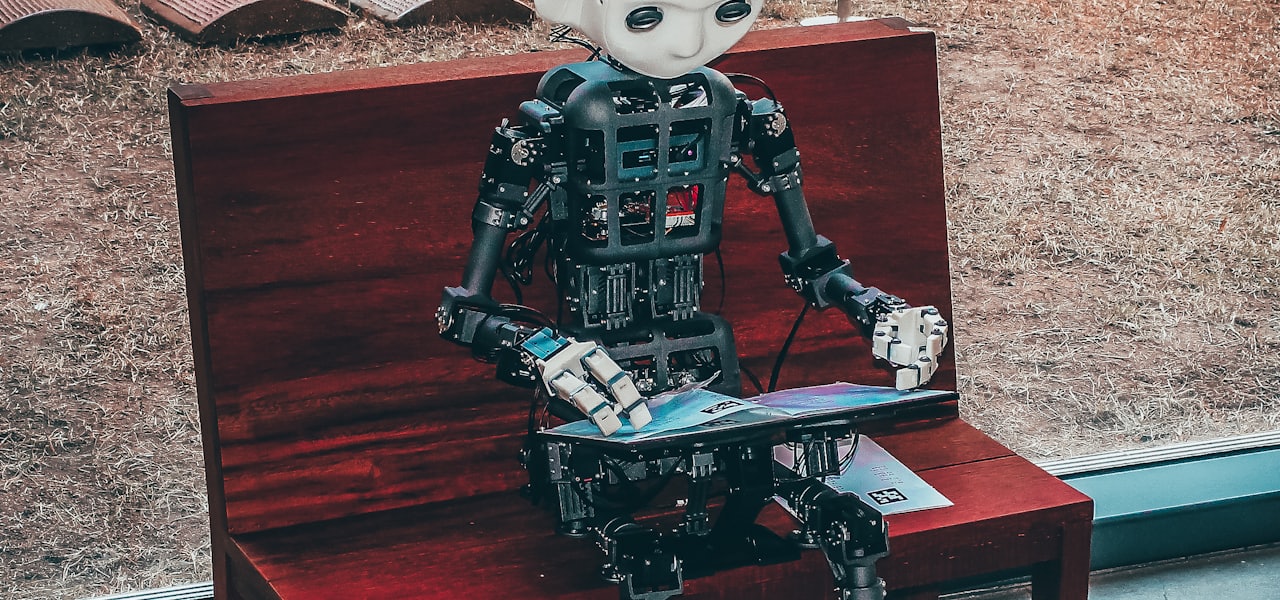
A companion robot is a robot created to create real or apparent companionship for human beings. Target markets for companion robots include the elderly and single children. Companions robots are expected to communicate with non-experts in a natural and intuitive way. They offer a variety of functions, such as monitoring the home remotely, communicating with people, or waking people up in the morning. Their aim is to perform a wide array of tasks including educational functions, home security, diary duties, entertainment and message delivery services, etc. The idea of companionship with robots has already existed on science fictions of 1970s, like R2-D2. Starting from the late 20th century, companion robots became a reality, mostly as robotic pets. Besides entertainment purposes, interactive robots were also introduced as a personal service robot for elderly care around 2000. == Characteristics == Companion robots try to interact with users. They gather information about users based on their interactions and yield feedback. This procedure varies slightly based on their specific roles. For example, social-companion robots make simple conversations, while pet-companion robots mimic being real pets. == Types == Companion robots can perform a variety of tasks and they are produced in a specialized manner according to their purpose or target audience in order to increase convenience and end user satisfaction. === Social companion robots === Social companion robots are designed to provide companionship and be a solution for unwanted solitude. They often mimic adult human, child or pet behaviours appealing to the user base. Robots which are specifically devised for simple conversations, conveying emotions and respond to user feelings fall under this category. === Assistive companion robots === Assistive companion robots are aimed at people who require constant care because of age, disability or rehabilitation purposes. Such robots can help disadvantaged users with their daily tasks, act as reminders (e.g., for regular medication) and facilitate mobility in everyday actions. Assistive companion robots reduce the intensity of labour that should be performed by caretakers, nurses and legal guardians. === Educational companion robots === Educational companion robots perform tutorship for students, regardless of their ages, and can teach desired subjects with activities tailored for the user such as interactive assignments and games. Rather than replacing teachers and instructors, educational companion robots are aides to them. === Therapeutic companion robots === Designed for individuals coping with stress (PTSD in severe cases), anxiety and loneliness; therapeutic companion robots support users' emotional and mental wellbeing. Such robots can be utilized in hospitals and care facilities as well as dwellings where the distressed user may need the most help. Therapeutic companion robots bear a vast resemblance to assistive companion robots to the extent of being a branch of them; the nuance between these two types of companion robots is that the former is for long-term/lifetime usage while the latter is mostly for the duration of the therapy received by the user. === Pet companion robots === Pet companion robots are for individuals who seek an alternative to live pets as live animals demand a considerable amount of care and may not be eligible for people with allergies. These robots aim to be perfect imitations of a pet while diminishing the chore aspect of having one. === Entertainment companion robots === Entertainment companion robots are designed solely for entertainment and can provide numerous ways of entertainment, ranging from dancing to playing games with the user. People who would appreciate an individual to have fun with are the main audience of such products. === Personal assistant robots === Personal assistant robots help people with daily tasks, management, scheduling, reminding etc. Their area of activity can be offices as well as homes and public spaces. === Sex robots === Sex robots are anthropomorphic robotic sex dolls that have human-like movement or behavior, and some degree of artificial intelligence. As of 2026, although elaborately instrumented sex dolls have been created by a number of inventors, no fully animated sex robots yet exist. Simple devices have been created which can speak, make facial expressions, or respond to touch. There is controversy as to whether developing them would be morally justifiable. In 2015, robot ethicist Kathleen Richardson called for a ban on the creation of anthropomorphic sex robots with concerns about normalizing relationships with machines and reinforcing female dehumanization. Questions about their ethics, effects, and possible legal regulations have been discussed since then. == Examples == There are several companion robot prototypes, and these include Paro, CompanionAble, and EmotiRob, among others. === Paro === Paro is a pet-type robot system developed by Japan's National Institute of Advanced Industrial Science and Technology (AIST). The robot, which looked like a small harp seal, was designed as a therapeutic tool for use in hospitals and nursing homes. The robot is programmed to cry for attention and respond to its name. Experiments showed that Paro facilitated elderly residents to communicate with each other, which led to psychological improvements. === CompanionAble === This robot is classified as an FP 7 EU project. It is built to "cooperate with Ambient Assistive Living environment". The autonomous device, which is also built to support the elderly, helps its owner interact with smart home environment as well as caregivers. The robot functions as a mobile friend, by which natural interaction is possible via speech and the touchscreen to detect and track people at home. === EmotiRob === EmotiRob is developed in a robotics project which is the continuity of the MAPH (Active Media For the Handicap) project in emotion synthesis. The aim of the project was to maintain emotional interaction with children. EmotiRob designed in a way that a child can hold it in a his/her arms and with which he/she could interact by talking to it, and then the robot would express itself through body postures or facial expressions. It has cognitive capabilities, which are further extended so that the robot can have a natural linguistic interaction with its owner through the DRAGON speech-recognition software developed by a company called NUANCE. Such interaction is expected to facilitate a child's cognitive development and develop new learning patterns. === LOVOT === Lovot is a Japanese company robot whose only purpose is "to make you happy". It features over 50 sensors that mimic the behavior of a human baby or small pet, a 360° camera with a microphone, the ability to distinguish humans from objects, neoteny eyes, and an internal warmth of 30° celsius. An interactive Lovot Café was opened in Japan October 3, 2020. === NICOBO === Nicobo was developed by Panasonic and was influenced by the loneliness of lockdowns created as a measure of the COVID-19 pandemic. It was designed to appear vulnerable, which creates empathy in its owners. Nicobo's name derives from the Japanese word for "smile". It wags its tail, engages in baby talk, and stays as a housemate. === Hyodol === Hyodol is an advanced care robot designed to support the elderly by reminding them to take their medications and monitoring their movements to keep their guardians informed. Additionally, this innovative robot can detect and respond to the emotional states of its elderly users, adding a layer of personalized care. Hyodol is designed with the appearance and speech style of a 7-year-old Korean grandchild, featuring a soft fabric exterior and user interaction methods such as striking the head or patting the back. It is equipped with various sensors and wireless communication technologies to collect and process data, supporting mobile apps and PC web monitoring systems for remote monitoring from anywhere. In South Korea, approximately 10,000 Hyodol robots are deployed to the homes of elderly individuals living alone, providing essential support and companionship. Local governments, including provincial and county offices, have embraced Hyodol as a solution to address social challenges stemming from the country's rapidly aging society.Furthermore, the robot is widely utilized in the treatment of dementia patients at a university hospital in Gangwon province. Hyodol was honored with the Mobile World Congress (MWC) Global Mobile Awards (GLOMO) in the "Best Mobile Innovation for Connected Health and Wellbeing" category on February 29, 2024. === Moxie === Moxie was a companion robot for autistic children developed by a company called Embodied. Although it had limited motion, it presented itself as a lifelike avatar. It was designed to help the children learn emotional cognition, using remotely hosted large language models to direct its respons
Software component
A software component is a modular unit of software that encapsulates specific functionality. The desired characteristics of a component are reusability and maintainability. == Value == Components allow software developers to assemble software with reliable parts rather than writing code for every aspect. It makes implementation more like factory assembly than custom building. == Attributes == Desirable attributes of a component include but are not limited to: Cohesive – encapsulates related functionality Reusable Robust Substitutable – can be replaced by another component with the same interface Documented Tested == Third-party == Some components are built in-house by the same organization or team building the software system. Some are third-party, developed elsewhere and assembled into the software system. == Component-based software engineering == For large-scale systems, component-based development encourages a disciplined process to manage complexity. == Framework == Some components conform to a framework technology that allows them to be consumed in a well-known way. Examples include: CORBA, COM, Enterprise JavaBeans, and the .NET Framework. == Modeling == Component design is often modeled visually. In Unified Modeling Language (UML) 2.0 a component is shown as a rectangle, and an interface is shown as a lollipop to indicate a provided interface and as a socket to indicate consumption of an interface. == History == The idea of reusable software components was promoted by Douglas McIlroy in his presentation at the NATO Software Engineering Conference of 1968. (One goal of that conference was to resolve the so-called software crisis of the time.) In the 1970s, McIlroy put this idea into practice with the addition of the pipeline feature to the Unix operating system. Brad Cox refined the concept of a software component in the 1980s. He attempted to create an infrastructure and market for reusable third-party components by inventing the Objective-C programming language. IBM introduced System Object Model (SOM) in the early 1990s. Microsoft introduced Component Object Model (COM) in the early 1990s. Microsoft built many domain-specific component technologies on COM, including Distributed Component Object Model (DCOM), Object Linking and Embedding (OLE), and ActiveX.
Pixel binning
Pixel binning, also known as binning, is a process image sensors of digital cameras use to combine adjacent pixels throughout an image, by summing or averaging their values, during or after readout. It improves low-light performance while still allowing for highly detailed photographs in good light. Charge from adjacent pixels in CCD or charge-coupled device image sensors and some other image sensors can be combined during readout, increasing the line rate or frame rate. In the context of image processing, binning is the procedure of combining clusters of adjacent pixels, throughout an image, into single pixels. For example, in 2×2 binning, an array of 4 pixels becomes a single larger pixel, reducing the number of pixels to 1/4 and halving the image resolution in each dimension. The result can be the sum, average, median, minimum, or maximum value of the cluster. Some systems use more advanced algorithms such as considering the values of nearby pixels, edge detection, self-claimed "AI", etc. to increase the perceived visual quality of the final downsized image. This aggregation, although associated with loss of information, reduces the amount of data to be processed, facilitating analysis. The binned image has lower resolution, but the relative noise level in each pixel is generally reduced. == History == Normally, an increase in megapixel count on a constant image sensor size would lead to a sacrifice of the surface size of the individual pixels, which would result in each pixel being able to catch less light in the same time, thus leading to a darker and/or noisier image in low light (given the same exposure time). In the past, camera manufacturers had to compromise between low-light performance and the amount of detail in good light, by dropping the megapixel count like HTC did in 2013 with their four-megapixel "UltraPixel" camera. However, this results in less detailed images in daylight where enough light is available. With pixel binning, the camera has "the best of both worlds", meaning both the benefit of high detail in good light and the benefit of high brightness in low light. In low light, the surfaces of four or more pixels can act as one large pixel that catches far more light. For example, some smartphones such as the Samsung Galaxy A15 are able to capture photographs with up to fifty megapixels in daylight. However, in low light, the individual pixels would be too small to capture the light needed for a bright image with the short exposure time available for handheld shooting. Therefore, with pixel binning activated, the 50-megapixel image sensor acts as a 12.5-megapixel image sensor, a quarter of its original resolution, with an accordingly larger surface area per pixel.
D/Vision Pro
D/Vision Pro was one of the earliest marketed non-linear editing systems. It was released by TouchVision Systems, Inc. in the mid-1990s. The program was DOS-based and worked on either Intel's 386 or 486 processor. The system used AVI compression and worked with the Action Media II board. The system allowed users to digitize video, audio, and timecode, create an edit decision list (EDL), instantly play back the edited program, and output the finished EDL in a wide variety of formats. These cost-effective editing systems were used by numerous independent filmmakers and in low-budget productions during the mid-late 1990s. D/Vision Pro's low-quality compression led TouchVision (later renamed D/Vision Systems) to abandon it in favor of D/Vision Online, which was purchased by Discreet Logic and renamed edit. In June 2002, Discreet discontinued edit, as they did not want it to interfere with smoke sales which were more profitable. Discreet was later purchased by Autodesk.
Alias Eclipse
Eclipse was a professional 2D image editing program available on Silicon Graphics and Windows workstations. Designed to manipulate high-resolution images like digitized movie frames and photographs for print, it offered color correction tools, image processing effects, rudimentary paint features, and spline-based drawing and masking. == History == Eclipse was originally developed in the late 1980s by Full Color Computing, an early provider of photo retouch and color prepress software for Silicon Graphics workstations. Alias Research (later Alias Systems Corporation), a developer of professional 3D graphics applications for the SGI platform, purchased the rights to Eclipse in fall 1990. Alias developed Eclipse through the early to mid-1990s, releasing version 2.5 in 1995 with improvements to the speed of color correction, effects, and rendering. Xyvision's Contex Prepress division purchased exclusive rights to Eclipse from Alias in 1996, and released version 3.0 the following year. Eclipse was subsequently sold to German developer Form & Vision GmbH, which continued development and ported it to the Windows platform. In 1999, Form & Vision released a demo of Eclipse 3.1.3 on the SGI platform which was limited to 1600 x 1600 pixel images, then ceased development of Eclipse on the SGI platform. Eclipse was thereafter developed exclusively for the Windows platform, culminating with version 3.1.4 in 2001. In the same year the firm went bankrupt. == Features == Eclipse was designed to work with very large images that could not be manipulated in real time on contemporary computer systems due to memory limitations, and thus allowed the user to make modifications to a lower-resolution copy of the original image in "proxy mode." Brush strokes, color corrections, and other edits were saved in proxy mode, then applied to the full-size image in post processing. This method also allowed for batch processing of a high-resolution image sequence using the edits applied to the original proxy image. Other features included color correction and separation, warping, special effects, text, and shape masking. Wavelet image compression created by LuraTech was added to Eclipse 3.1.4
United States Tech Force
The U.S. Tech Force (also styled as US Tech Force, Tech Force, or Government Tech Force) is a federal hiring initiative launched by the second Donald Trump administration in December 2025. The program, administered by the Office of Personnel Management (OPM), aims to recruit about 1,000 early-career technology professionals into two-year government jobs to modernize federal IT systems, advance artificial intelligence (AI) capabilities, and address technological gaps in government operations. The initiative is an effort to plug capability gaps created by Trump-administration efforts to shrink the federal government, which led to the departure of some 220,000 federal employees, including many in IT. The initiative seeks early-career workers; officials said it would offer competitive salaries and opportunities to work on high-impact government technology projects. Major technology companies—including Amazon, Apple, Microsoft, Nvidia, Meta, Google, and OpenAI—agreed to help identify and refer candidates. Candidates are allowed to take Tech Force positions on leaves of absence and without divesting their stock, raising conflict-of-interest questions. In January 2026, OPM direction Scott Kupor said the deadline for applying to Tech Force was being extended because of "tremendous interest" without saying how many people had actually applied. Also in December 2025, news broke that the administration is planning another novel use of private-sector workers: hiring cybersecurity firms for offensive cyber operations.
Clubhouse (app)
Clubhouse is an American social audio app for iOS and Android developed by Alpha Exploration Co. that enables users to participate in real-time, audio-only communication within virtual "rooms". Launched in March 2020 by Paul Davison and Rohan Seth, the platform is characterized by its "drop-in" nature, where users can join live discussions on a wide range of topics as either listeners or speakers. The application gained attention in early 2021, operating on an invite-only model and featuring appearances from public figures such as Elon Musk, Oprah Winfrey, and Mark Zuckerberg. During this period, Clubhouse reached a reported valuation of approximately $4 billion and contributed to the expansion of similar social audio features like Twitter Spaces and Spotify Greenroom. The app later expanded to Android in May 2021 and removed its waitlist in July 2021, opening access to the general public. == History == Clubhouse began as an invite only social media startup by Paul Davison and Rohan Seth in Fall 2019. Originally designed for podcasts with the name Talkshow, the app was rebranded as "Clubhouse" and officially released for the iOS operating system in March 2020 and as of May 2021 the Android systems as well. Clubhouse was valued at $100 million after receiving funding from notable angel investors. These investors included Ryan Hoover (Founder, Product Hunt), Balaji Srinivasan (Former CTO, Coinbase), James Beshara (Co-Founder, Tilt.com), and several venture capitalists, including a $12 million Series A investment from the venture capital firm, Andreessen Horowitz, in May 2020. The app gained popularity in the early months of the COVID-19 pandemic. It had 600,000 registered users by December 2020. In January 2021, CEO Paul Davison announced that the active weekly user base on the app consisted of approximately 2 million individuals. The company announced that it would start working on an Android version of the app. In that month, the app became widely used in Germany when German podcast hosts Philipp Klöckner and Philipp Gloeckler began an invite-chain over a Telegram group. It brought German influencers, journalists, and politicians to the platform. Clubhouse raised their Series B at a $1 billion valuation. On February 1, 2021, Clubhouse had an estimated 3.5 million downloads on a global level which grew rapidly to 8.1 million downloads by February 15. This significant growth in popularity was because celebrities such as Elon Musk and Mark Zuckerberg made appearances on the app. In the same month, Clubhouse hired an Android Software Developer. A year after the app's release, the number of weekly active users was greater than 10 million, but the user base declined 21% during three weeks from late February to early March. This decline was reportedly caused by a decrease in the number of Clubhouse users after its initial release. During its initial roll out, the app was accessible only by invitation, and invitation codes on eBay were selling at up to $400. On April 5, 2021, Clubhouse partnered with Stripe to launch its first monetizing feature called Clubhouse Payments. Although testing began with only 1,000 users, after a week, the company rolled out the functionality to another 60,000 or more users in the US. In the same month, Twitter entered in discussions to purchase Clubhouse for $4 billion. The talks ended with no acquisition. Later, the company raised their Series C round of funding at a $4 billion valuation. The app also received interest in a partnership, with the National Football League announcing a content deal that month; Twitter Spaces later poached Clubhouse's exclusive NFL deal with 20 official NFL Spaces scheduled for the 2021-22 season. Finally, On May 9, 2021, Clubhouse launched a beta version of the Android app for users in the US, and on May 21, 2021, Clubhouse became available worldwide for Android users. In July 2021, Clubhouse announced a partnership with TED to offer exclusive talks. and on July 21, 2021, the company discarded its invitation system and made the application available to all, though a wait list for registration was still applied in order to manage new traffic. As of the time of the announcement, the company stated it had 10 million users on the wait list. On September 23, 2021, the company announced a new feature named "Wave". In October 2021, Clubhouse rolled out new features called "Replays and Clips". In April 2023, the company announced it was reducing its staff by half amid a "resetting" due to post-pandemic market shifts. == Features == === Rooms === The primary feature of Clubhouse is real-time virtual "rooms" in which users can communicate with each other via audio. Rooms are divided into different categories based on levels of privacy. Moderator roles are denoted by a green star that appears next to the user's name. When a user joins a room, they are initially assigned to the role of a "listener" and cannot unmute themselves. Listeners can notify the moderators of their intent to join the stage and speak by clicking on the "raise hand" icon. Users who are invited to the stage become "speakers" and can unmute themselves. Users can exit a room by tapping the "leave quietly" button or with the help of peace sign emoji. === Houses === In August 2022, Clubhouse announced a feature called Houses, an invite-based version of the rooms. === Events === A lot of conversations in Clubhouse are of spontaneous nature. However, users can schedule conversations by creating events. While scheduling an event, users can first name the event and then set the date and time at which the conversation will begin. Users can also add co-hosts to help moderate the event. Once the event has been created, it is added to the Clubhouse "bulletin". The bulletin shows upcoming scheduled events and allows users to set notifications for events by clicking the bell icon corresponding to the event. Users can access the bulletin by clicking on the calendar icon at the top of the home page. === Clubs === At the Clubhouse, clubs are user communities that regularly discuss a common interest. Many clubs are present in Clubhouse which represents a wide array of topics. Users can find clubs by name under the search tab. A club consists of three categories of users: "Admin", "Leader", and "Member". Members can create private rooms and invite more users into the club. Leaders have all the privileges of a member. Apart from that, they are authorized to create/schedule club-branded open rooms. An admin can modify club settings, add/delete users, change user privileges and create/schedule any type of room. There are three types of clubs: "Open", "By Approval", and "Closed" for membership. Any user can join an open club by pressing the "Join The Club" button on the club profile. In case of approval, users need to apply and wait for membership by clicking the "Apply To Join" button on the club profile. The admins of the respective club are privileged to accept or reject the user's request. In a closed club, membership is limited to users selected by the club admin. All users of a club will be notified when a public room within the club is created. The club creation is restricted to active users and whoever creates the club will become the club admin. Eligible users can create a club by going to their profile, press the "+" sign present in the "Member of" section. Clubs in which a user is a member are shown on their profile page. The first club to half a million members was the Human Behavior Club founded by The Digital Doctor (Dr. Sohaib Imtiaz). === Backchannel === Backchannel is the messaging function which allows users to interact individually or within a group via text. The Backchannel feature was initially leaked on June 18, 2021, in response to the launch of Spotify Greenroom. This is notable step because, until this point, Clubhouse was voice only with no way to hyperlink or message. It was entirely dependent on Instagram and Twitter for text messaging. The feature was initially leaked in the App Store, which the company says was an accident on Twitter. A month later, after multiple failed attempts, the Clubhouse Backchannel finally launched on July 14, 2021. === Explore === The homepage of Clubhouse provides access to ongoing chat rooms, which are recommended based on the people and clubs that are followed by the user. As the users tap on the magnifying glass icon, they will be redirected to the explore page. On that page, users can search for people and clubs to follow and also find conversations categorized by topics. === Clubhouse Payments === This is the direct payment service provided by the app, which allows users to send money to content creators. It includes those users who had enabled this functionality in their profile. Money can be sent from users to the creator by clicking on their profile. Press "Send Money" then enter the amount you want to send. When a user does this for the first time, they'll be prompted to reg